(cont.)
Wednesday, November 15th, 2006. 6pm, on the road back to Addis Ababa from Nazareth.
“Selam – hello – I love you!” “Selam – hello – I love you!” “Selam – hello – I love you!”
And still the kids keep coming forward, crowding around me with beaming faces and skinny arms outstretched to shake hands – several faces I recognise from handshakes just a few moments earlier, coming back for more.
“Selam”, I reply, having finally learnt and remembered just one word of Amharic, and tentatively brandish my cameraphone a couple of times in the direction of the leaping, waving, squealing swarm of children.
Marcus the photographer and I certainly caused a stir as we delved through a Nazareth village market, taking photos – and making a sudden celebrity – of 67-year-old grocery kiosk-keeper Khadija Mohammed. She patiently “sold” and resold and resold one bunch of browning bananas to a ragged yet graceful pretend customer, as Marcus snapped away beneath the booth’s low counter, having crawled awkwardly through a catflap-esque entrance at the back.
The shop can have been no bigger than the homes we saw yesterday, only this had relatively “rich” pickings spilling from the shelves: Glory biscuits, Fegegta crackers, Aladdin’s Constant mystery mixture, Scissors safety matches, more familiar yet miniaturised bags of Ariel Gold Plus washing powder, and a deep barrel of bright red lentils.
A few paces ahead of her stall, a small but severe-looking boy guarded a sack of corn, underneath a billowing brown canvas and alongside an older man who would occasionally stand and flourish a long thin stick in mock anger if the surrounding swells became too boisterous. A younger, slightly smarter man was on constant walkabout with a half-brush, half-whip in his right hand, lightly slapping the legs of any curious child who wandered too close while walking home from school – albeit never with much malice or backlift.
Their clothes may have been long-worn and spare, but they range from finely-arranged shawls and gowns to freshly-faded modern sports sweatshirts – sad to say, more often than not showing off an Arsenal badge. As here in Nazareth, 100km from the capital, so seemingly across Ethiopia – Solomon confirmed the suspicion, this is Gooner territory, save for the occasional knock-off top preferring Barca (10 Ronaldinho) or Manchester United (8 Rooney).
Such familiar fashionwear contrasts smartly with the all-pervading poverty and dated, crudely painted eyesores above eye level – here in Nazareth perhaps more so than even in Addis Ababa. Here, ramble goats, back-breakingly burdened donkeys, emaciated horses with savagery in their eyes. In Addis we had seen men randomly sprawled asleep on the kerbsides – across Nazareth, diagonal canvas strips mark out barely-there excuses for “homes”, more claustrophobic and debasing than a dog’s kennel.
Children seize amusement from riling a pet goat whose back foot is thinly tethered to a tree – swiping his horned head with a couple of quickfire volleys, only sometimes provoking enough of an effort to buck and barge in vain. (If the sight reminded me of the scene in Evelyn Waugh’s Scoop, and the hotel’s resentful pet goat who must inevitably escape from his ties in a fictional, factional Abyssinia-alike African nation-in-turmoil Ishmaelia, at least we were spared this goat’s eventual vengeance.)
Khadija’s small success – and may today’s attention hopefully give business a decent little boost – offers a sign of how people here can be helped to help themselves. The Nazareth Community Development Project, since its inception in June 2002, has enrolled 2,400 women into its “income-generation activities” – grassroots collective groups offering funding, business training, pooled profits and communal savings schemes for the “poorest of the poor , invariably the town’s women, engaged in such activities as embroidery, weaving, cattle-fattening, vegetable oil-mixing, sheep-rearing and engura-baking (enguar, the sour bread that is a beloved national staple, despite looking especially unappetising to us – rather resembling a Swiss roll of soggy concrete, or a furl of sloppy, paste-mired wallpaper – and tasting not a lot better. Ah, but “give us this day our daily engura”, our hosts cheerily implore – and we, equally cheerily, oblige.)
The IGA groups – split into SHGs (self-help groups) of between 15 and 20 people, and CLAs (cluster level associations) of eight to 12 SHGs – are now in the black to the tune of 487,000 Birr in savings – about £30,000. Funding for individual or group initiatives comes from members’ own contributions (20 per cent), Tearfund (ten per cent), the Kale Heywet church (ten per cent) and Dutch-based charity Dorkas Aid International.
As might be expected, especially in such a patriarchal society, many men were initially suspicious of such a women-led project, fearing – or, at least, dismissively claiming – the meetings would be little more than idle gossip shops. But as the money began trickling in – 100 Birr on a good day for mother-of-six Khadija, for example – so they started seeing a sunnier side. Now, one woman rejoiced: “My husband is the one who cleans the chairs every time we have a meeting here ahead.”
Although we discovered Khadija was HIV- - not too helpful, after all the photos, for our Aids-centred coverage; ah, how cynical – and the scheme is for the benefit of everyone and anyone, co-ordinator Mekonnen Kelsede explained how HIV+ women had much to gain – by participating, and empowering themselves, and also as other women boost their own livelihoods enough to contribute to communal care. Meanwhile, spin-off schemes involve building much-needed new homes, clothing children, improving – or, indeed, introducing – literacy and numeracy.
It could even seem a throwback to – or long-awaited implementation of – pure Communist principles. That is, had it not been for the over-indulgent sprinklings of business jargon – “capacity-building”, “targeted beneficiaries”, “economic stability”, I ask you...
All of which would no doubt be lost, for the foreseeable anyway, on the little kids now extending their palms for a different purpose, as we clamber into our van after taking our farewells.
“Money! Money!”, the understandably ask of the rich white men all of a sudden in their midst, potentially wielding power or patronage over them. But before we can even awkwardly, properly respond, our driver is spearing into second gear, Solomon shooing the last hordes away with barely a glance, and we’re literally lost in a cloud of dust.
What can you do?
But then again, what could they do? “Money!” “Money!” Well, why not...?
(cont.)
Tuesday, November 14th, 2006. 5pm, Hotel Desalegn, Addis Ababa.
Smart, pristine pink new apartment blocks are rising from the rubble in the Tele Bulgaria sub-city, a rare display of modern-day development and optimism – and pretty much misleading.
Every apartment so far stands empty– save for a tottering stepladder glimpsed through one darkened window. And getting anyone able to afford to move in might be a momentous challenge – it looks tricky enough to simply remain in one of the squalid rusty shacks that make for “accommodation” (a generous term indeed) down below, next-door and across the capital.
One of these useless blocks stands as a cruel backdrop to a jumble ofunsafe rocks, low-flying clothes-lines and patter of traipsing children andmice-sized kittens leading into the unhappy home of bed-ridden Aids patient Mikre Mesele – dank dwellings in which she may have just four more days,with the prospect of worse uncertainty ahead.
I don’t think I’ll ever quite forget the first moment of stooping, stepping in. Even by all expectations of Ethiopian poverty and squalor, this is something else. The shack is in darkness as we struggle in, barely room for Mikre’s bed upon which she can barely be seen, and even then looking moredead than even barely-alive. Another bed lies at a right angle, astonishingly sub-rented out by Mikre to raise a little desperately-needed cash – while the merest scrap of hard flooring is all that serves as a painful resting-space for daughters Betamariam Selshie, nine, and five-year-old Alemayhu.
A crackling lightbulb, dangling across the room on a rickety wire, gives a flicker of vision, as Mikre’s frail frame arches an inch or two up from herpillow, croakily sharing with us how her landlord has given her four days to leave this hovel for which she pays 80 Birr per month (about $10 – and a rip-off at a tenth of the price). He apparently wants to renovate the place– but this is surely his second attempt to evict Mikre purely for her HIV status, after only an indignant neighbours’ revolt forced him to back down shortly after Mikre’s diagnosis six months ago.
She could never afford the higher charges he is proposing – as things stand at the moment anyway, the rent leaves her with just 20 Birr per month from the grant handed over by the capital’s – and the church’s – Medan Acts programme.
Agonisingly raising her head against the old-newspapers-matted tin wall, an improbable “London-New York-Paris”-sloganned sports bag perched somehow above her, Mikre can only frown as school-uniformed Alemayhu bounds blithely inside, before just as instantly chasing a kitten back out again.
“Even before I became ill, everything was very difficult and complex,” Mikre explains. “Sometimes there were days when we had to go without any food at all. WhenI could get hold of something, we’d eat – if not, we couldn’t.”
Life was made more arduous when Aids claimed the life of her husband three years ago. Like many of the people we meet, Mikre appears to have left most of her family behind in distant countryside, migrating to Addis in search of work, in desperate expectation of a better life somehow. Twelve years after travelling 650km from Gondar, now 25-year-old Mikre can only depend on the daily calls of home carer Sisaoibeyene, one of a dwindling band of tireless, unpaid volunteers. The Medan intervention at least means fewer days of starvation, as Sisaoibeyene bakes a daily disc of loaf, while the children have also been kitted out with school uniforms and packed off to their lessons.
Mikre was married for eight years before her husband’s death – suggesting she was just 14 when they wed. He was the main bread-winner – or‘bread-owner’, as Solomon translates it, a transitory moment of mild amusement – making his plunge into bed-ridden torpor an even more crushing setback. Yet again, like many we encounter, Mikre appears incredibly philosophical and unself-centred about her plight.
“I was extremely saddened by the situation – not so much because I was afraid for myself, that I would be infected, but that the kids would go even more without – about our whole poverty and style of life, more than my husband having the virus.”
After realising she too was positive, Mikre now spends her days lying helpless, unable to stir enough even to boil a rusty kettle or cover over the cat-mess-mired plates scattered aside.
“At first when I fell ill, I was really very upset – I lost all hope, Ididn’t have the energy to go out and get something for the children to eat. But after the project started helping me, my hope renewed a bit. I just can’t lose all hope. There were times I felt so bleak – I just didn’t know what to do. But I’m not personally worried about my own situation, about myself – I just heavily regret I can’t really do something good for my children. I’m worried about their future. People in foreign lands need to really focus on our children.”
The past seems to be something to be forgotten without fuss – from the bloody repression of the 17-year Communist era, to the loss of individual loved ones – to the signing of your own HIV death warrant
Two impassive portraits hang lop-sided above Tariku Leta’s bed – the faces of the parents who died within a month of each other this summer.
But ask 15-year-old Tariku or 12-year-old brother Girma about their recent losses, and their steady-eyed replies are all about how they are coping with the present – and preparing for the future. The pair have had to grow up quickly, momentously, during the past year, now living alone together in one cabin while partitioning and hiring out their parents’ old room next-door to raise a little rent.
Girma still goes to school – though he has returned now for lunch after an unusually-inactive morning. Tariku has dropped out, and juggled such jobs as shoeshine boy, carpenter’s assistant and sheet metal worker to pay the family’s way. And while Girma still looks a baby-faced boy, Tariku has the fixed gaze and severe voice of someone many years more mature than his actual age.
“Because of trying to make ends meet, we haven’t really had time to play and enjoy things with the rest of the community kids round here,” he shrugs sombrely. “We didn’t get to enjoy childhood like we should have done, like others do.” Do they have any pleasures or distractions at all? “No, none. We’re leading a serious life of older people.”
The extended family lives 125km away, placing the burden of their parents’ care formidably onto the meagre shoulders of the two boys – and increasing the isolation as they mourned.
“When we lost our parents, we lost all hope. Our lives were completely shattered,” recalls Tariku, who takes his name from the father who died aged 47. Mother Ananetch was 35 when she died in May.
“In the past, we never really cared about anything – we never worried about where breakfast, lunch or supper came from. Now we have to cook forourselves – and earn enough money to buy food in the first place. Life has completely changed, and things are really getting more expensive,especially as we grow.
“I feel responsible for my little brother – I have to make sure he goes to school, for the sake of his future. But for now, only one of us can earn. Iwork in a metal shop but some days, like today, there’s no work for me to do – and no pay.”
A smattering of stationery sits in the corner, supplied to studious Girma by the people at Medan. Tariku has also been promised some wheat, and hopes soon to sign up to an income-generation scheme – typically, involving a $100 grant to start selling a little home produce, whether agricultural or arty-and-crafty.
He and Girma also have higher aspirations – both want one day to become doctors, a legacy of seeing their parents suffer so: “We want to be doctors because we want to participate in the kind of ordeal our parents went through. We want to make sure these things don’t happen to other people.”
Tariku quickly checks himself, loath to dwell too long on those dying days: “The past is gone. Our parents are no more with us. It’s pointless for us to think about them. We’d rather choose to concentrate on our current situation. We don’t really spend any time thinking about the past.”
Yet there are clearly some moments when bleaker memories can steal upon them unawares, often under cover of treacherous sleep. Yes, there are bad dreams – bad, because they seem good, softly-spoken Tariku allows: “Sometimes I find myself in some kind of nostalgia about our past lives, when both our parents were alive. And we get upset, reminded of the good lives we used to lead.
“That’s why we try not to think of it at all.” Men sadly forced into maturing ahead of schedule – and yet sometimes still, boys will, and must, be boys again.
Senait Dender’s home is no larger, nor any more luxurious, than a toilet cubicle – in fact, that’s what it was before a relative made the merest of alterations to allow her and baby son Yonas to move in. A sunken bed, a stiff sky-blue shawl on the wall and – well, that’s about it, a grubby baby’s bottle in the corner aside.
Before coming here eight months ago, the pair were sleeping in the streets under a flimsy blanket, having being thrown out of her uncle’s home by a mistrustful aunt and a vindictive landlord’s ultimatum: either the HIV girl goes, or the whole family.
The sight of huddled-up Senait, 22, dripping tears over Yonas in their mudbank-set settlement is sad enough – but her back-story is even bleaker: raped at 14 by the head of a household where she worked as a babysitter; forced to give up the resulting child, now nine, to a faraway aunt; infected with HIV at the age 18 by a here-today-gone-tomorrow boyfriend; then later deserted by her husband, the father of Yonas, after being laid low by HIV and opportunistic diseases such as TB.
Her husband, a soldier, initially assured Senait he was being transferred to serve in another part of the country, only for her later to discover him living elsewhere in Addis Ababa still, wanting nothing to do now with his wife and then-six-month-old child.
Yonas keeps crawling, calling for a scrap of notepaper, happily banging a stray pen against our pads, occasionally squealing, on the verge of tears and a tantrum that don’t quite come. His mother taps her fingers on his head in admonition, jabs the filthy-teated bottle into his mouth and awkwardly adjusts her rheumatism-riddled legs folded underneath her – too weak to take a walk outside, to show off her son down the scruffy-kiosked pathway.
Yet she insists she is through the worst of her sickness, having responded encouragingly to TB treatment and now a month into her course of anti-retroviral drugs: “I hope and pray that God might give me my full health back, so I can work and raise my baby myself. I have very strong hope and faith because a couple of years ago I was so ill, people were expecting me every day to die– I was virtually paralysed. If I’ve passed through those difficult days, even now I have hope of being fully healed. I’ve been ten times worse than this.”
But still, but still… “The worst days are at holiday times, like New Year or Christmas, when I see people enjoying themselves, rejoicing, visiting each other – and I find myself closeted in my room, with no one coming to visit me. Or at any time if I see or hear someone laughing or having a good time, I remember the good days I had in the past. When I could work. When I could earn my own living. When I had my dignity. Those days come back to me, and it’s very difficult. Even when people bring me food, it doesn’t taste good because of the state I’m in.”
Ah, but at least she smiled for the first time as we handed over a couple of rolls left over from (an inevitably guilty-feeling) lunch – having first checked with helpful Dr Henok whether to offer would be appropriate. (“Appropriate”? What an awkward and stupid sense of complacent Western“propriety” – hand them over, and let her and baby tuck in, for goodness’sake Aidan… He didn’t say that, of course…)
We left Yonas happily munching his surprise “treat”, and bump back to the hotel – through Confusion Square, the oh-so-aptly-nicknamed expanse of traffic chaos that makes Piccadilly Circus look like a deserted country highway; past the Medan Acts base where this morning factory worker Daniel Mekonin was a shivering bundle of nerves as he faced an HIV test, only to stride away relieved and thumbs up to us 20 minutes later, one of the lucky ones; past the “James Bond tailors” and the “Snow White laundry”, the traffic lights where a frantic wanderer raps on our windows and apparently angrily accuses me of being a Chinese billionaire exploiting his Ethiopian slaves (“Every country has its madmen”, Solomon sighs) – back to the all-the-roomier-now hotel room, to ponder, touched, on life’s shocking lottery.
Tuesday, November 14th, 2006. 5pm, Hotel Desalegn, Addis Ababa.
Smart, pristine pink new apartment blocks are rising from the rubble in the Tele Bulgaria sub-city, a rare display of modern-day development and optimism – and pretty much misleading.
Every apartment so far stands empty– save for a tottering stepladder glimpsed through one darkened window. And getting anyone able to afford to move in might be a momentous challenge – it looks tricky enough to simply remain in one of the squalid rusty shacks that make for “accommodation” (a generous term indeed) down below, next-door and across the capital.
One of these useless blocks stands as a cruel backdrop to a jumble ofunsafe rocks, low-flying clothes-lines and patter of traipsing children andmice-sized kittens leading into the unhappy home of bed-ridden Aids patient Mikre Mesele – dank dwellings in which she may have just four more days,with the prospect of worse uncertainty ahead.
I don’t think I’ll ever quite forget the first moment of stooping, stepping in. Even by all expectations of Ethiopian poverty and squalor, this is something else. The shack is in darkness as we struggle in, barely room for Mikre’s bed upon which she can barely be seen, and even then looking moredead than even barely-alive. Another bed lies at a right angle, astonishingly sub-rented out by Mikre to raise a little desperately-needed cash – while the merest scrap of hard flooring is all that serves as a painful resting-space for daughters Betamariam Selshie, nine, and five-year-old Alemayhu.
A crackling lightbulb, dangling across the room on a rickety wire, gives a flicker of vision, as Mikre’s frail frame arches an inch or two up from herpillow, croakily sharing with us how her landlord has given her four days to leave this hovel for which she pays 80 Birr per month (about $10 – and a rip-off at a tenth of the price). He apparently wants to renovate the place– but this is surely his second attempt to evict Mikre purely for her HIV status, after only an indignant neighbours’ revolt forced him to back down shortly after Mikre’s diagnosis six months ago.
She could never afford the higher charges he is proposing – as things stand at the moment anyway, the rent leaves her with just 20 Birr per month from the grant handed over by the capital’s – and the church’s – Medan Acts programme.
Agonisingly raising her head against the old-newspapers-matted tin wall, an improbable “London-New York-Paris”-sloganned sports bag perched somehow above her, Mikre can only frown as school-uniformed Alemayhu bounds blithely inside, before just as instantly chasing a kitten back out again.
“Even before I became ill, everything was very difficult and complex,” Mikre explains. “Sometimes there were days when we had to go without any food at all. WhenI could get hold of something, we’d eat – if not, we couldn’t.”
Life was made more arduous when Aids claimed the life of her husband three years ago. Like many of the people we meet, Mikre appears to have left most of her family behind in distant countryside, migrating to Addis in search of work, in desperate expectation of a better life somehow. Twelve years after travelling 650km from Gondar, now 25-year-old Mikre can only depend on the daily calls of home carer Sisaoibeyene, one of a dwindling band of tireless, unpaid volunteers. The Medan intervention at least means fewer days of starvation, as Sisaoibeyene bakes a daily disc of loaf, while the children have also been kitted out with school uniforms and packed off to their lessons.
Mikre was married for eight years before her husband’s death – suggesting she was just 14 when they wed. He was the main bread-winner – or‘bread-owner’, as Solomon translates it, a transitory moment of mild amusement – making his plunge into bed-ridden torpor an even more crushing setback. Yet again, like many we encounter, Mikre appears incredibly philosophical and unself-centred about her plight.
“I was extremely saddened by the situation – not so much because I was afraid for myself, that I would be infected, but that the kids would go even more without – about our whole poverty and style of life, more than my husband having the virus.”
After realising she too was positive, Mikre now spends her days lying helpless, unable to stir enough even to boil a rusty kettle or cover over the cat-mess-mired plates scattered aside.
“At first when I fell ill, I was really very upset – I lost all hope, Ididn’t have the energy to go out and get something for the children to eat. But after the project started helping me, my hope renewed a bit. I just can’t lose all hope. There were times I felt so bleak – I just didn’t know what to do. But I’m not personally worried about my own situation, about myself – I just heavily regret I can’t really do something good for my children. I’m worried about their future. People in foreign lands need to really focus on our children.”
The past seems to be something to be forgotten without fuss – from the bloody repression of the 17-year Communist era, to the loss of individual loved ones – to the signing of your own HIV death warrant
Two impassive portraits hang lop-sided above Tariku Leta’s bed – the faces of the parents who died within a month of each other this summer.
But ask 15-year-old Tariku or 12-year-old brother Girma about their recent losses, and their steady-eyed replies are all about how they are coping with the present – and preparing for the future. The pair have had to grow up quickly, momentously, during the past year, now living alone together in one cabin while partitioning and hiring out their parents’ old room next-door to raise a little rent.
Girma still goes to school – though he has returned now for lunch after an unusually-inactive morning. Tariku has dropped out, and juggled such jobs as shoeshine boy, carpenter’s assistant and sheet metal worker to pay the family’s way. And while Girma still looks a baby-faced boy, Tariku has the fixed gaze and severe voice of someone many years more mature than his actual age.
“Because of trying to make ends meet, we haven’t really had time to play and enjoy things with the rest of the community kids round here,” he shrugs sombrely. “We didn’t get to enjoy childhood like we should have done, like others do.” Do they have any pleasures or distractions at all? “No, none. We’re leading a serious life of older people.”
The extended family lives 125km away, placing the burden of their parents’ care formidably onto the meagre shoulders of the two boys – and increasing the isolation as they mourned.
“When we lost our parents, we lost all hope. Our lives were completely shattered,” recalls Tariku, who takes his name from the father who died aged 47. Mother Ananetch was 35 when she died in May.
“In the past, we never really cared about anything – we never worried about where breakfast, lunch or supper came from. Now we have to cook forourselves – and earn enough money to buy food in the first place. Life has completely changed, and things are really getting more expensive,especially as we grow.
“I feel responsible for my little brother – I have to make sure he goes to school, for the sake of his future. But for now, only one of us can earn. Iwork in a metal shop but some days, like today, there’s no work for me to do – and no pay.”
A smattering of stationery sits in the corner, supplied to studious Girma by the people at Medan. Tariku has also been promised some wheat, and hopes soon to sign up to an income-generation scheme – typically, involving a $100 grant to start selling a little home produce, whether agricultural or arty-and-crafty.
He and Girma also have higher aspirations – both want one day to become doctors, a legacy of seeing their parents suffer so: “We want to be doctors because we want to participate in the kind of ordeal our parents went through. We want to make sure these things don’t happen to other people.”
Tariku quickly checks himself, loath to dwell too long on those dying days: “The past is gone. Our parents are no more with us. It’s pointless for us to think about them. We’d rather choose to concentrate on our current situation. We don’t really spend any time thinking about the past.”
Yet there are clearly some moments when bleaker memories can steal upon them unawares, often under cover of treacherous sleep. Yes, there are bad dreams – bad, because they seem good, softly-spoken Tariku allows: “Sometimes I find myself in some kind of nostalgia about our past lives, when both our parents were alive. And we get upset, reminded of the good lives we used to lead.
“That’s why we try not to think of it at all.” Men sadly forced into maturing ahead of schedule – and yet sometimes still, boys will, and must, be boys again.
Senait Dender’s home is no larger, nor any more luxurious, than a toilet cubicle – in fact, that’s what it was before a relative made the merest of alterations to allow her and baby son Yonas to move in. A sunken bed, a stiff sky-blue shawl on the wall and – well, that’s about it, a grubby baby’s bottle in the corner aside.
Before coming here eight months ago, the pair were sleeping in the streets under a flimsy blanket, having being thrown out of her uncle’s home by a mistrustful aunt and a vindictive landlord’s ultimatum: either the HIV girl goes, or the whole family.
The sight of huddled-up Senait, 22, dripping tears over Yonas in their mudbank-set settlement is sad enough – but her back-story is even bleaker: raped at 14 by the head of a household where she worked as a babysitter; forced to give up the resulting child, now nine, to a faraway aunt; infected with HIV at the age 18 by a here-today-gone-tomorrow boyfriend; then later deserted by her husband, the father of Yonas, after being laid low by HIV and opportunistic diseases such as TB.
Her husband, a soldier, initially assured Senait he was being transferred to serve in another part of the country, only for her later to discover him living elsewhere in Addis Ababa still, wanting nothing to do now with his wife and then-six-month-old child.
Yonas keeps crawling, calling for a scrap of notepaper, happily banging a stray pen against our pads, occasionally squealing, on the verge of tears and a tantrum that don’t quite come. His mother taps her fingers on his head in admonition, jabs the filthy-teated bottle into his mouth and awkwardly adjusts her rheumatism-riddled legs folded underneath her – too weak to take a walk outside, to show off her son down the scruffy-kiosked pathway.
Yet she insists she is through the worst of her sickness, having responded encouragingly to TB treatment and now a month into her course of anti-retroviral drugs: “I hope and pray that God might give me my full health back, so I can work and raise my baby myself. I have very strong hope and faith because a couple of years ago I was so ill, people were expecting me every day to die– I was virtually paralysed. If I’ve passed through those difficult days, even now I have hope of being fully healed. I’ve been ten times worse than this.”
But still, but still… “The worst days are at holiday times, like New Year or Christmas, when I see people enjoying themselves, rejoicing, visiting each other – and I find myself closeted in my room, with no one coming to visit me. Or at any time if I see or hear someone laughing or having a good time, I remember the good days I had in the past. When I could work. When I could earn my own living. When I had my dignity. Those days come back to me, and it’s very difficult. Even when people bring me food, it doesn’t taste good because of the state I’m in.”
Ah, but at least she smiled for the first time as we handed over a couple of rolls left over from (an inevitably guilty-feeling) lunch – having first checked with helpful Dr Henok whether to offer would be appropriate. (“Appropriate”? What an awkward and stupid sense of complacent Western“propriety” – hand them over, and let her and baby tuck in, for goodness’sake Aidan… He didn’t say that, of course…)
We left Yonas happily munching his surprise “treat”, and bump back to the hotel – through Confusion Square, the oh-so-aptly-nicknamed expanse of traffic chaos that makes Piccadilly Circus look like a deserted country highway; past the Medan Acts base where this morning factory worker Daniel Mekonin was a shivering bundle of nerves as he faced an HIV test, only to stride away relieved and thumbs up to us 20 minutes later, one of the lucky ones; past the “James Bond tailors” and the “Snow White laundry”, the traffic lights where a frantic wanderer raps on our windows and apparently angrily accuses me of being a Chinese billionaire exploiting his Ethiopian slaves (“Every country has its madmen”, Solomon sighs) – back to the all-the-roomier-now hotel room, to ponder, touched, on life’s shocking lottery.

Monday, November 13th, 2006. 6pm. Hotel Desalegn, Addis Ababa, Ethiopia.
"I have to be satisfied, just prolonging someone’s life a little..."
Hmm. Let’s start with the simpler perceptions, maybe to ease a little less awkwardly into the trickier. There’s a deckchair on the balcony, and a furry soft bed and long-drawn bath in the rest of the room. Across the street, a well-meaning European Union office flutters a flag promising “We believe in partnership”, as toy car-resembling baby-blue-and-white taxis wait languidly for any spare fares.
Further down the street from this cosy-ish, Westerner-oriented hotel, broken barricades of corrugated tin occasionally back away from garish, makeshift market stalls selling scraps of cloth, slabs of greasy red meat or the ever-essential bottles of water. Rising unsteadily above there might be a token attempt at a modern-day building boom, a half-formed monster of concrete dominated by tree-twig scaffolding and more resembling the blasted-out skeleton of a multi-storey car park.
A few jam-packed white vans veer across and alongside the occasional cab fortunate enough to find a paying customer, but the pedestrians comprise the heavier traffic, heavily bearing on shoulders a haul of fruit, a swinging timber ladder, or a a swaddle of shawls that must surely house a baby somewhere inside. Modestly paved and signposted highways suddenly swerve into rocky dirt tracks, the only coherent clues offered by shoddily-plonked French language pointers for invading foreign ambassadoires.
So, here I am in Ethiopia, that apparent by-word for starvation and suffering, pity pity and yet more pity. Caught in an uneasy clash of instincts, between wanting to project a more optimistic, forward-looking, famine-downplaying image - read all about it, the latest trade deal signed with, say, China, or France, in the parched-dry Government-led propaganda Press - and yet of necessity acknowledging the many, many human catastrophes every day, every where you look, thanks (thanks) to relentless epidemics; never-ending shortages of essential supplies, sanitation and medication; corruptly-misspent millions; and tokenistic international ignorance.
The Ethiopian embassy in London complains about the “unhelpful”, “negative images used by the media”. Solomon, one of our guides for this Tearfund-led trip, bitterly points out footage of the 1984 famine is still being passed off as present-day by some media organisations. There are the rich-ish coffee, cotton, sugar and gold to be mined here, the recent surges in cereal production, coffee exports, school access and attendance…
Ah, but then there are the doomed babies’ faces and fragile, flailing limbs - or the actually-older children yet so riddled with disease they could easily pass for newly-out-of-the-womb. These are the harder to see, to think of again afterwards - the in-and-out-and-in-again patients at the Zewditu Memorial Hospital - a former US mission facility, later confiscated by the 1974-1991 Communist government, yet now hailed by this regime as a national flagship, despite looking and feeling more like a grim, neglected old council estate - stale air and despair struggling through each cramped corridor and narrow crowded staircase. Some 600 children are regularly being treated on the mould-encrusted wards, where waste bins overflow with used needles and inter-mingling gunge.
Here, heartbreakingly, is two-year-old Mersi Kassahum, a chubby, uncomprehending face on a bizarrely barrel-chested torso yet a stick-spindly pair of drip-fed legs - HIV+ just like 23-year-old mother Nardos, both condemned to the disease by a father and husband long since fled, leaving them and a ten-strong extended family abandoned on the outskirts of the capital.
Nardos seems jarringly philosophical, even cheery as she poses patiently for necessarily-posed photos - but there also seems a tinge of denial as she insists: “I don’t want to really worry very much about HIV. What’s done is done. So I have to live with it, for myself and my daughter. This is the only outlet that could mean my child survives. It’s not important to worry about something that’s already been done. It’s not worth worrying about my husband now he’s left. There’s nothing I can do about it.”
But the unstinting aid workers out here are determined that something, much more, can be done - especially before infection, before it’s too late. Prevention of mother (or parent) to child transmission seems to be the keynote theme this year for Tearfund, especially in the run-up to World Aids Day on December 1.
One 200mg tablet of Neviraprine for the mother as she enters labour - plus a 2mg/kg dose of the same for baby up to 72 months of delivery - can apparently vastly reduce the risk of an HIV infection being passed on. Such treatments can cost less than $10 per mother - yet many still go without, in a country of between 180,000 and 200,000 HIV+ pregnancies every year and up to 80,000 babies born with the infection. Some 25,000 children died due to Aids last year, according to Ministry of Health records - but many believe thousands more are going unreported.
If a mother is HIV+, her unborn child has about a one-in-three chance of inheriting the infection - of the 35 per cent who do, 15 to 20 per cent are infected during pregnancy, up to half during delivery, and about 33 per cent through breast-feeding. The dangers linger for some months.
So much for the statistics. Mersi was here for her sixth admission to hospital. In another white cage bed, blinking and grimacing under fluorescent light, 16-month-old Amanuel is here for the first time, and has been for just a few days. Brought in for diarrhoea, tests quickly revealed a more devastating diagnosis - HIV+, like both his parents - as well as associated tooth and jaw corrosion, and ominous patches of sores across his tender skin.
Paediatrics director Dr Wondewosen Desta sighs: “Nistartine would be the right drug for his oral problems, but it’s too expensive for us - we have to use a $2 oral gel instead, and hope for the best. It’s all so frustrating, for us and for the family. My friends are giving up their jobs - it’s too much, to see 50 or 60 per cent of your child patients with HIV. Most of them have repeated admissions. I have to be satisfied, just prolonging someone’s life a little. If we treat this child properly, he may make it to school one day. But more than one-third don’t get to celebrate their first birthday if we can’t treat them.”
Sometimes the gender roles are reversed - not often, but once or twice, here or there. Engeta Muhamed, 30, watches phlegmatically over toothily-grinning son Nudana, six years old but looking more like a baby, swamped inside regulation hospital green sleeves and rolling charming, cloying eyes at the camera. Engeta says his wife left him to bring up Nudana alone - a hard task anyway for a more-often-than-not unemployed labourer whose best daily wage would be $1.50, barely adequate for food and often forcing him to go begging instead.
“He’s still coughing, he’s not feeding well,” Engeta explains. “I know he’ll probably have to stay here for a month - after that, who knows? Of course I’m worried. I’ll have to leave my boy here and go out looking for work - but I can never earn enough. Every life’s like that here - everyone has to beg.”
Nor do the staff escape, both emotionally and physically - a flimsy, sloppily-slipped-on surgical glove, offering too little protection from cuts, or a grisly and deadly splash of blood to an eye: such accidents have ultimately claimed the lives of at least five workers in this department alone in recent years.
The illustrated children’s posters on the wall look merely sad, hopeless gestures: “Clean Face Prevents Trachoma” - “Let us make child vaccination our culture.”
Hopefully, a few rather more assuring signs of hope amid all the misery might, might just emerge over the coming days...
Well, I'm off shortly to Ethiopia, have just about packed my bags full of anti-itch and anti-malaria medications, and cotton T-shirts for the days, woolly jumpers for the evenings... Will leave you all in the capable hands of these two little thugs...

What are you looking at?
Gooooooooood grief (love the crooked stripe)...


What are you looking at?
Gooooooooood grief (love the crooked stripe)...

"Sad eyes, you are the only whose blue skies are grey..."
University life is to blame for foisting upon me one of those addictions that has cost much expense ever since, while also inflicting a fair degree of pain and discomfort.
Then again, it did get me just at my most vulnerable, as an all-too-fresh Fresher. I saw other people doing it - people who looked instantly cooler, more confident, more attractive to the opposite sex. Knowing one of the secret foundations of their apparent assurance didn't lessen its appeal, only made those expensive accoutrements all the more inviting, all the more exciting.
So, one day, after much hovering and havering, I finally plucked up my courage and indulged. Finally, I became one of those really adult adults who were actually doing it, from the first glimmering snap of dawn to the last shrug of nightfall, youthfully reckless of the consequences either later in life or the sticky sensations of the next morning...
Yes, I became one of them. I, too, started... wearing contact lenses.
Okay, it took a little while to get the knack of transporting contact lens from point A, the tip of my index finger, to point B, my actual eye.
The optician below stairs in the Guild building certainly had his patience sorely tried, as he repeatedly insisted he couldn't let me toddle off without having managed the transaction at least once, but each and every time, as my eyes slapped shut at the last split-second as that fragile little bowl of transparent gloop approached a little too close, he let slip the merest of sighs before gently encouraging me to try again...
... only to eventually, eyes on the end-of-the-working-day clockface, encourage me: "Well, keep practicing at home, good luck..." and ushering me out, a pack of several months' and bottle of lotion clutched proudly in hand...
And I did, a whole Saturday and most of Sunday screwing up my face in my 15h floor mirror and those of my contact-lens tutors on the sixth floor - failing all too many times, until finally - Eureka! - finding myself with perfect vision through my right eye, and after that magical moment, managing to slip them in and out and in and out with arrogant ease.
And I could see again. No need to squint quite so often at the lecture-room overhead projections, nor whip out a glasses case quite so guiltily and surreptitiously between car door and steering wheel...
Of course, they sometimes go astray. Several times a too-energetic rub of my bleary eyes has resulted in that little soft-plastic disc taking a detour up into my forehead, only making its way back home at great, frustrating length.
Catherine was once delayed in making her way downstairs for the trek into campus, having inexplicably stabbed a contact lense into the eye into which she'd only just prodded the other.
And then, after veering between daily, fortnightly and monthly treatments, I was abruptly told by an optician I needed to stop wearing contacts "like, yesterday". At which point - probably the stolid airless, garish-lighted ambience of the consulting room was to blame - I must admit taking a bit of a totter, the once-a-year-or-so flash of blue and black lights smudging across my sights and leaving me with nothing in mind but the overwhelming desire to collapse and lie sprawled across the floor (a tip: try to avoid such sensations occurring when doorstepping people you want to interview, and who really don't want to be interviewed by you, on a rather sensitive but newsworthy subject... A tale for another day, maybe...)
Still, despite the red blood cells apparently too quick to rise too close to the surface of my eyes, and the thinly-rimmed, top-half-slightly-blackened specs I've been forced to wear much of the time, I stick in a couple of contacts for as many social occasions as I can, out of a useless and in-vain vanity that refuses to see the bespectacled me as the real me, somehow...
The bloodshot eyes have been a little more in evidence recently, since I'm down to my last pair of emergency contacts while waiting for the latest batch of refresheners due in September, and on complaint, the substitute batch apparently posted out last week. No, no sign...
Maybe it's for the best. I just dislike shaving with these restricted-vision-scan glasses on, I always miss a bit...
Still, at least I have my eyes still. I've been starting to think about investing in laser surgery, once seeming a too-distant too-extravagant dream, but now apparently down to about £400 per eye. A colleague had both his done for free, on the promise of writing a puff piece about the procedure at some later date. Huh. I could do that job...
But still, £800 doesn't sound too exorbitant, for all the hassle and cost it might magically wipe out for, well, a little while. One to look into (arf) in the New Year, perhaps...
Ah, but. I was wincing tears this evening when stopping home to see my mum, who in the midst of perhaps the worst week of our lives for other reasons, today had to have several injections and then stitches in and around her left eye for the removal of a skin cancer tumour. And now lies, understandably woebegone, on the living-room sofa, squinting at EastEnders through an angry-blood-streaked slash, a bludgeon of purple bruises.
As the necessary eyedrops were administered, her's weren't the only ones welling up...
But I had it lucky, I know.
Lasers, lenses - luxury...
Then again, it did get me just at my most vulnerable, as an all-too-fresh Fresher. I saw other people doing it - people who looked instantly cooler, more confident, more attractive to the opposite sex. Knowing one of the secret foundations of their apparent assurance didn't lessen its appeal, only made those expensive accoutrements all the more inviting, all the more exciting.
So, one day, after much hovering and havering, I finally plucked up my courage and indulged. Finally, I became one of those really adult adults who were actually doing it, from the first glimmering snap of dawn to the last shrug of nightfall, youthfully reckless of the consequences either later in life or the sticky sensations of the next morning...
Yes, I became one of them. I, too, started... wearing contact lenses.
Okay, it took a little while to get the knack of transporting contact lens from point A, the tip of my index finger, to point B, my actual eye.
The optician below stairs in the Guild building certainly had his patience sorely tried, as he repeatedly insisted he couldn't let me toddle off without having managed the transaction at least once, but each and every time, as my eyes slapped shut at the last split-second as that fragile little bowl of transparent gloop approached a little too close, he let slip the merest of sighs before gently encouraging me to try again...
... only to eventually, eyes on the end-of-the-working-day clockface, encourage me: "Well, keep practicing at home, good luck..." and ushering me out, a pack of several months' and bottle of lotion clutched proudly in hand...
And I did, a whole Saturday and most of Sunday screwing up my face in my 15h floor mirror and those of my contact-lens tutors on the sixth floor - failing all too many times, until finally - Eureka! - finding myself with perfect vision through my right eye, and after that magical moment, managing to slip them in and out and in and out with arrogant ease.
And I could see again. No need to squint quite so often at the lecture-room overhead projections, nor whip out a glasses case quite so guiltily and surreptitiously between car door and steering wheel...
Of course, they sometimes go astray. Several times a too-energetic rub of my bleary eyes has resulted in that little soft-plastic disc taking a detour up into my forehead, only making its way back home at great, frustrating length.
Catherine was once delayed in making her way downstairs for the trek into campus, having inexplicably stabbed a contact lense into the eye into which she'd only just prodded the other.
And then, after veering between daily, fortnightly and monthly treatments, I was abruptly told by an optician I needed to stop wearing contacts "like, yesterday". At which point - probably the stolid airless, garish-lighted ambience of the consulting room was to blame - I must admit taking a bit of a totter, the once-a-year-or-so flash of blue and black lights smudging across my sights and leaving me with nothing in mind but the overwhelming desire to collapse and lie sprawled across the floor (a tip: try to avoid such sensations occurring when doorstepping people you want to interview, and who really don't want to be interviewed by you, on a rather sensitive but newsworthy subject... A tale for another day, maybe...)
Still, despite the red blood cells apparently too quick to rise too close to the surface of my eyes, and the thinly-rimmed, top-half-slightly-blackened specs I've been forced to wear much of the time, I stick in a couple of contacts for as many social occasions as I can, out of a useless and in-vain vanity that refuses to see the bespectacled me as the real me, somehow...
The bloodshot eyes have been a little more in evidence recently, since I'm down to my last pair of emergency contacts while waiting for the latest batch of refresheners due in September, and on complaint, the substitute batch apparently posted out last week. No, no sign...
Maybe it's for the best. I just dislike shaving with these restricted-vision-scan glasses on, I always miss a bit...
Still, at least I have my eyes still. I've been starting to think about investing in laser surgery, once seeming a too-distant too-extravagant dream, but now apparently down to about £400 per eye. A colleague had both his done for free, on the promise of writing a puff piece about the procedure at some later date. Huh. I could do that job...
But still, £800 doesn't sound too exorbitant, for all the hassle and cost it might magically wipe out for, well, a little while. One to look into (arf) in the New Year, perhaps...
Ah, but. I was wincing tears this evening when stopping home to see my mum, who in the midst of perhaps the worst week of our lives for other reasons, today had to have several injections and then stitches in and around her left eye for the removal of a skin cancer tumour. And now lies, understandably woebegone, on the living-room sofa, squinting at EastEnders through an angry-blood-streaked slash, a bludgeon of purple bruises.
As the necessary eyedrops were administered, her's weren't the only ones welling up...
But I had it lucky, I know.
Lasers, lenses - luxury...
"Can we play you every week...?"
Jose Mourinho, John Terry, Ron "Chopper" Harris, Kerry Dixon, Sebastian Coe, David Mellor, David Baddiel, Damon Albarn, Suggs, Johnny Vaughan, Bubble from "Big Brother", Frank Arnesen, John Major...
Can you hear me, John Major?
Your boys took one hell of a beating.
Your boys took one hell of a beating.

Your boys took one hell of a beating...!

Phew, that was a long time coming.
Here's to two decades - at least - of us always doing for them now...
GET IN!

"What became of the people...?"
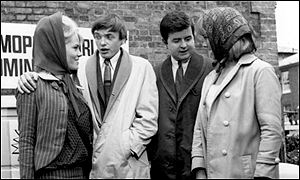
It was a special moment, the first time we heard the banns of marriage announced in the local church for my brother Noel and his putative bride Vicky.
I was proud, oh so proud... of myself, for not bursting out laughing when the rector asked whether anyone knew any just cause or impediment, why these two may not be joined together in lawful matrimony...
But only because such a scenario can only but call to mind the scene from "Whatever Happened To The Likely Lads?", when Thelma and Bob's banns are greeted by, at the back of the church, Terry bursting out: "Scarborough???!!"
A lovely moment, and just shades the very-similar middle-name-revealing moment in "Only Fools And Horses", to the embarrassment of Rodney Charlton Trotter.
I love Seventies sitcoms - "Rising Damp", "Steptoe And Son", "Porridge", the underrated "The Lovers"... but "... Likely Lads" is specially charming, albeit dependent on coincidental meetings even more often than a Thomas Hardy novel.
Even if Bolam and Bewes were perhaps not quite the besta buddies their screen personalities may have suggested, I defy anyone not to sit in front of a Likely Lads repeat, even at 5.25pm on a bustlingly busy Saturday evening and not want the world to stop, in fact rewind a couple of decades, and just indulge even in the most faded-grey of North-East warehouse backdrops, for at least a greasy slurp of Newky Broon or several...
But it's too, too easy to assume the "Whatever Happened To..." Seventies incarnation is the only one worth treasuring. I dimly recall, about a decade or so ago, BBC2 replaying a few of the original black-and-white "Likely Lads" episodes, and they seemed rather tame curiosities, but I've recently been re-watching the first series, and those shows are much more treasurable and, indeed, incisive then expected.
Okay, the odd scraps of dialect and dialogue seem dated - yet worth resurrecting, especially the lovely replacement-oath, "by the cringe"...
But there's so much more subtlety, while yet camaraderie and nicely-timed crudity (no, not finely-cut salad) than in any of yer too-blunt "Men Behaving Badly"...
Okay, Rodney Bewes isn't a great actor at all, in fact splinteringly wooden for mant scenes. But James Bolam is a joy to watch throughout, as much for his simian reacting as his acting while delivering his indignant or impish lines.
And Sheila Fearn as his sister Audrey is one of the most underrated character roles of any British sitcom, alternately pert and prudish, and bringing the best out of her "brother".
"She's a nice girl, Pat."
- "'Course she is. Good legs, too."
"Can't you think about higher things for a change?"
- "... Yeah, they're not bad an' all..."
If nothing else, the series has encouraged me to use the word "kidder" more often.
Just because.
And the Terry'n'Bob approach to returning to grim Blighty from foreign holidays is probably the best approach towards dreary disappointment...
"Did you have any troubles with the language barrier?"
- "Language barrier? Had a bit of bother understanding them Brummies, didn't we, Bob?"
Or, indeed...
"By the time you've chatted up one foreign bird, you could have had three English ones..."
Well, er... maybe, maybe not...
But anyway:
"Seaside? What does she think we are - working class?"
But anyway.
I can forgive Ferris and Collier anything.
Well, almost anything.
Everything... except this:
"Hey, Terry - the Spurs lost!"
- "Champion!"
I preferred them when their only football result was England F-...
Subscribe to:
Posts (Atom)